

5 August 2026
I thought I would take a break from novelizing “Socks” today and spend a little time sharing my perspectives and advice on the arts of writing and storytelling.
I don’t claim to be an expert in either art form, though I will recommend the names of several individuals who are – in my estimation – worth your attention and study. Like most everyone, my understanding of writing and storytelling developed first as a consumer of literature and cinema. Observing that some stories were well-written and other stories were not, then spending time trying to discern what made “the good” good and “the bad” bad. I benefited from fantastic teachers growing up who provided me with a very good education in English. That education was refined further during law school, emphasizing technical precision and persuasion, transforming me into a professional writer. I would later try my hand at writing horror fiction (though that venture failed for reasons I didn’t understand at the time). Years later, I wrote an original stage adaptation of “Frankenstein”, and shortly thereafter began the process of writing the original screenplay for “Socks”.
It was during my tenure as president of a community theatre (coinciding with the production of “Frankenstein”) that I found it necessary to compile and organize what I knew into advice that I could share with my collaborators.
I would make a poor teacher of writing mechanics and proper English, not because I am unfamiliar with the technical rules of grammar, but because I lack the patience for teaching those fundamentals. That said, I cannot stress enough how important it is to get a good education in English and writing. Writing is fundamentally about communicating. If you want to communicate your ideas to another person… If you don’t want to be misunderstood by others… Then the proper and accurate use of language is imperative.
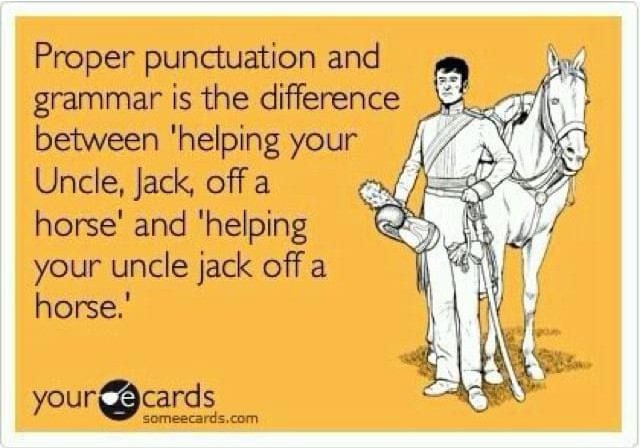
The art of writing is tragically undervalued these days. I grew up during the proliferation of cell phones and Internet access, of text messages and of Twitter with its fucking 140 character limit. I grew up and watched as basic writing skills evaporated, replaced by heavy reliance on acronyms, abbreviations, and emoticons. People, like me, who gave a shit about proper writing were mocked as “Grammar Nazis”, despite there being no shortage of humorous memes proving how grammatical errors can lead to wildly different interpretations of the same text. Now we live in a world plagued with misunderstandings and mistakes because people don’t know how to communicate properly. For the sake of being understood and for the sake of being taken seriously – learn proper writing.
I would also suggest finding writers that you like and studying carefully how they use language in the artistic sense. Two of my favorites are Aaron Sorkin and John Logan. In fact, Aaron has a wonderful description of language that comes in the form of a quote from The West Wing episode “War Crimes” (2001): “Words, when spoken out loud for the sake of performance, are music. They have rhythm, and pitch, and timbre, and volume. These are the properties of music, and music has the ability to find us and move us, and lift us up in ways that literal meanings can’t.” Even if you’re not writing music or poetry, I have found it very important to listen to the music of written words, as those properties can be just as powerful as the words themselves.
Be fussy in your word choices, too. The English language is robust and filled with synonyms. But that doesn’t mean that words are interchangeable. Two words that mean roughly the same thing in the dictionary can carry very different connotation and weight and subtext depending on the context. Words are tools. Use the wrong tool, and maybe you can brute-force your way to understanding, but you’ll have a much easier time communicating your ideas if you use the right tools.
Of the subject of storytelling, I am much more opinionated.
While modern society might not place much economic value on culture and the arts, it is helpful to understand the important role that storytelling serves in our society. From an anthropological perspective, storytelling is how we communicate complex ideas, such as values, empathy, morality, life lessons, and how to cope with dilemmas. Not only do we use stories to share these ideas geographically and across cultures, but also from generation to generation through time.
Where so many aspiring writers go wrong at the most basic and elementary level is that they confuse story with plot and they confuse character with characterization. Plot is the sequence of events that occur within a story. A story communicates the human experiences that are revealed through events – the ideas, choices, values, changes, and life lessons that give the events meaning. Characterization consists of physical attributes and other surface-level observations of an individual in a story. Character defines the individual more deeply – through their values, priorities, passions, their ambitions, their fears – and those other qualities that determine how he behaves under pressure.
Stories with no meaning and empty characters are… garbage. Sorry – there was no nice way to put it. They are forgettable because they lack substance.
I’ve read a lot of bad stories and watched a lot of bad films in my life. And 90% of the time, what makes them bad –- you can tell — someone involved in the production had a great idea for something really cool they wanted to show off. Maybe it was an idea for a cool space battle. Maybe it was an idea for a creepy monster design. Maybe it was an idea for an exciting action and combat sequence. Maybe it was a string of really funny jokes. And what they did was develop a flimsy plot as the vehicle to deliver this cool thing they wanted to show off. And don’t get me wrong… this cool idea – might well be very impressive and entertaining. But at the end of the day, there was no strong story behind the cool idea, and the production was utterly forgettable.
I’ll give you some examples. While I was in charge of the community theatre, we had a director drop out at the last minute and we had to scramble to put together another production. Because we had limited time, we chose a play called “Cloak and Dagger”, written by Craig Sodaro, which was supposed to be a spoof of “Casablanca” – a cinematic classic that tells a very compelling story. In our haste, we hung our hat on that connection in the hopes that we were performing a decent story. After a couple of read-throughs, it was obvious that the script was hot garbage. It was very obvious from the writing that the author had the idea for some jokes and gimmicks, and he wrote the play around those jokes. But there was no substance there. We realized that too late and had to make the best out of the situation.
Not long after, I was toying with an idea to write a stage play – a highly meta story – in which the characters were actors rehearsing for a play (a play within a play) on a stage that was haunted. And the idea was to take all of the over-used tropes of the horror genre and turn them on their head. It was the very definition of “all gimmick, no substance”. And it sucked because of it. I tried to shoehorn a meaningful story into the plot in an effort to salvage the idea. But it was a poor fit. Ultimately, I abandoned that project (the gimmick, anyway). But that meaningful story I tried to shoehorn in? I kinda liked it. I kept it, played around with it a little bit, and before I realized it, I had the basic structure of the story that would would go on to become “Socks”.
Stories – good stories – are about relatable characters and how they grow and change over time. They’re about the decisions those characters make, the obstacles they overcome, the dilemmas they face. And when I say all of that, I know it sounds like I’m describing a serious and dour story, something you’d find in the drama section of your local bookstore or video rental store. But that’s not true at all. Stories of all genres – including horror, sci-fi, and even comedy can incorporate meaningful stories into them.
I use food as an analogy to explain the concept. Your story – your substantive, meaningful story – is like the meat and potatoes of your meal. Genre is how you decorate the story and make it entertaining – genre is like gravy. Or if you prefer a healthier metaphor, a good story is like a nutritious salad, and genre is the dressing we pour over the salad to make it more palatable. And to extend the food metaphor – the cool idea with no meaningful story – is marshmallow fluff, tasty for a moment, but of no substance or nutritional value.
A story with substance is something that is more likely to stick with the audience. Human beings relate to the characters in stories and can use the lessons learned in those stories to navigate the struggles of their own lives. Again – I use the terms “lessons” and “struggles” which makes a meaningful story sound serious. But even slapstick comedy – done well – has a meaningful story hidden deep beneath that sugary frosting.
Again – I’m not an expert on the art of storytelling. If you want to get better at the craft, I strongly encourage you to study Robert McKee. I’ve found his writings and teachings on the subject to be very insightful and helpful.

